Early OKC Knee Extensions in ACL Rehab: Myth, Science, and Clinical Decision-Making
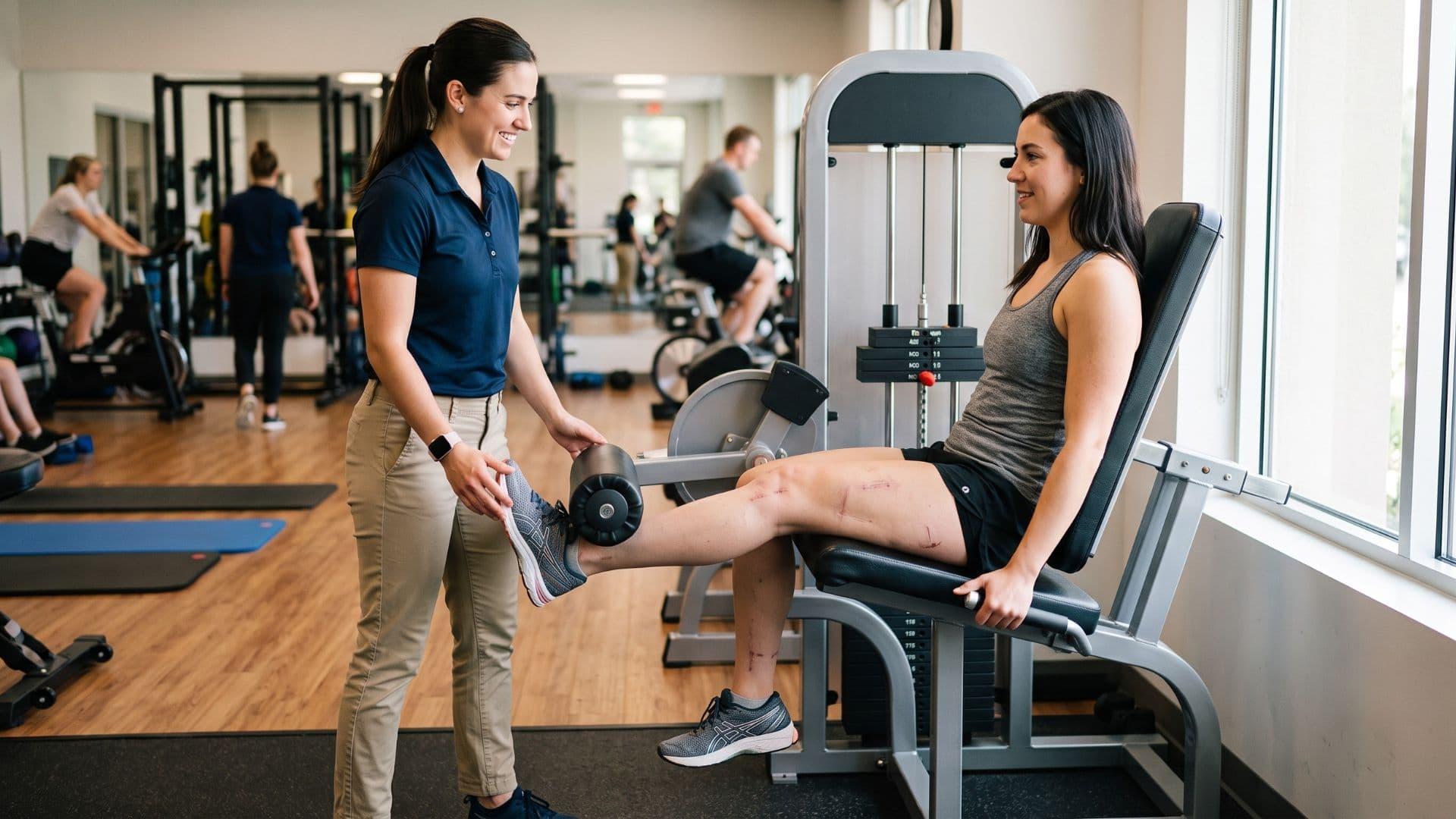
For decades, clinicians have hesitated to prescribe early open kinetic chain (OKC) quadriceps extensions post-ACL reconstruction, fearing graft elongation and increased sagittal laxity. But does current biomechanical evidence support complete avoidance?
A systematic review and meta-analysis by Fontanier et al. (2025) re-evaluates this long-standing clinical dogma. The data indicates that introducing controlled OKC extensions around 4 weeks post-surgery—specifically within a protected 90°–45° arc—does not compromise graft stability. More importantly, early isolated loading offers a targeted stimulus to overcome arthrogenic muscle inhibition, restoring quadriceps strength far more effectively than closed-chain training alone.
Explore the interactive infographic below for a deep dive into graft strain profiles, a week-by-week loading roadmap, and a clinical decision algorithm for your practice.

DEBUNKING THE OKC EXTENSION MYTH
For decades, clinicians feared open kinetic chain (OKC) knee extensions would stretch ACL grafts. The 2025 Fontanier et al. meta-analysis rewrites this dogma. Here is your evidence-informed framework for early, isolated quadriceps loading.
The Science: Fontanier et al. (2025) Breakdown
Zero Added Laxity
Instrumented testing confirms no clinically meaningful increase in anterior tibial translation when OKC is introduced at or after 4 weeks within modified arcs (90°–45°).
Superior Quad Recovery
Early isolated OKC loading yields +18–25% greater short-term quadriceps torque by overcoming arthrogenic muscle inhibition masked by closed-chain compensations.
Improved PROMs
Patients engaging in early OKC protocols demonstrated statistically significantly higher self-reported functional scores and improved psychological readiness at mid-term follow-ups.
Methodology & Biomechanical Insights
Study Design & Criteria
- Comprehensive Analysis: Systematic review and meta-analysis synthesizing both RCTs (RoB 2) and interventional cohort studies (ROBINS-I).
- Stratified Timeframes: Compared outcomes across early initiation (<4 weeks, 4–6 weeks) versus traditional delayed introduction (>6–12 weeks).
- Range of Motion Arc Impact: Evaluated restricted range extension (90° to 45°) versus full range (90° to 0°).
Why Arc Control Protects the Graft
ACL graft strain varies dynamically based on knee flexion angle during isolated quadriceps contractions:
Clinical Action Steps: The 3-Phase Timeline
Joint Quietness & Active Muscle Activation
Delay loaded open-chain extensions. Focus on achieving full passive extension (0°), controlling joint effusion, utilizing neuromuscular electrical stimulation (NMES), quad sets, straight leg raises, and closed-chain weight shifts.
Introduce Restricted Arc OKC Extensions
Begin isotonic seated knee extensions strictly within a 90° to 45° flexed arc. Use physical machine stops. Prescribe moderate loads (12–15 RM) to rebuild volume and reverse AMI.
Progress Flexion Range & Load Intensity
Gradually expand extension arc to 90° to 30°. If knee reaction remains quiet (no increase in effusion or patellofemoral pain), progress toward full extension (90° to 0°) by weeks 8–12, transitioning into heavy hypertrophic resistance (6–8 RM).
Dr. E's Practical Rules for Clinicians
Leg press and squats allow hip extensor compensation that disguises profound quadriceps inhibition. Isolated open-chain loading is required to directly stress and rebuild the quadriceps engine.
Never force open-chain extensions into an effused or angry knee joint. Effusion itself causes spinal reflex inhibition of the quad—clear swelling before adding heavy resistance.
Always set physical pin stops on knee extension equipment to limit movement to 90° to 45° during weeks 4–6. Verbal cueing alone fails under heavy effort.
Combine early restricted open-chain extensions with high-intensity electrical stimulation to maximize motor unit recruitment and accelerate strength recovery.
Learn my Eval, Reset, and Stabilize System
Get Rapid Results from the Cervical Spine to the Foot/Ankle and everything in between!